

From Galilee
Longer reflections on Scripture
The Drink Offering: Poured Out in the Levitical System - Received in the New Priesthood
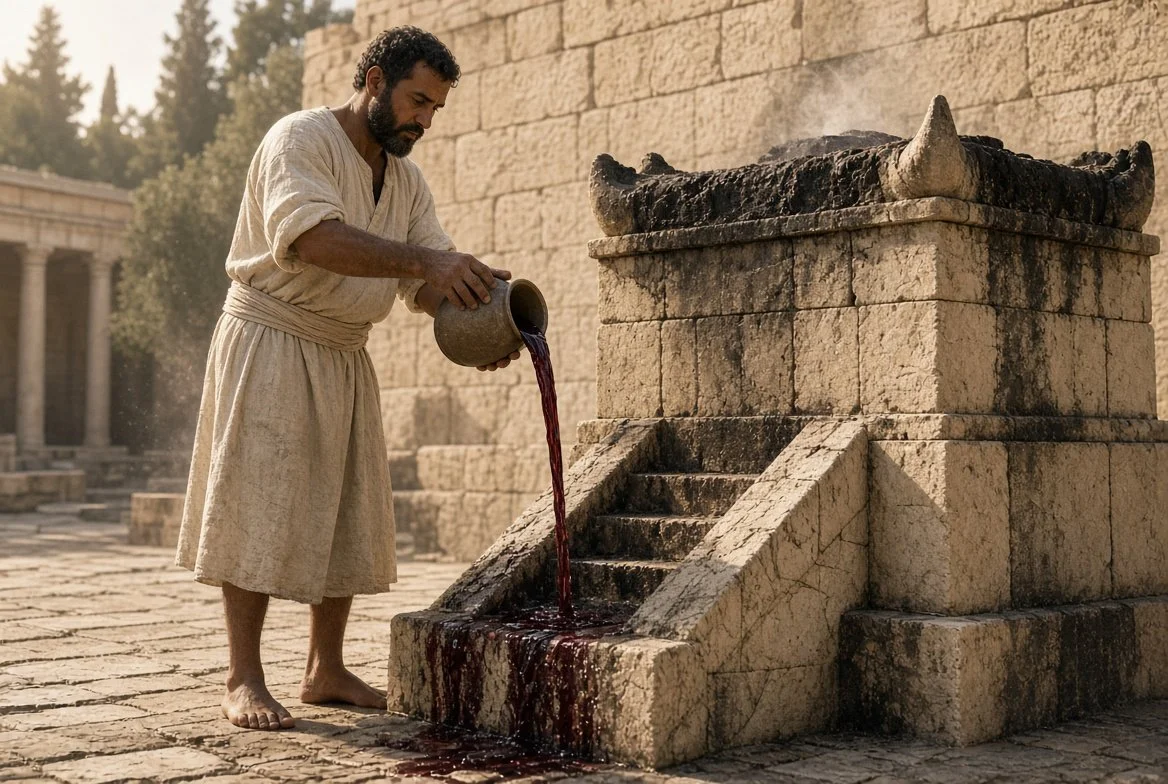
In the Levitical system the wine was poured out and never drunk. In the priesthood after Melchizedek it is poured out on the cross and received at the table.
Tracing the wine from the Aaronic order through Abraham’s line to its fulfillment in Christ after the order of Melchizedek.
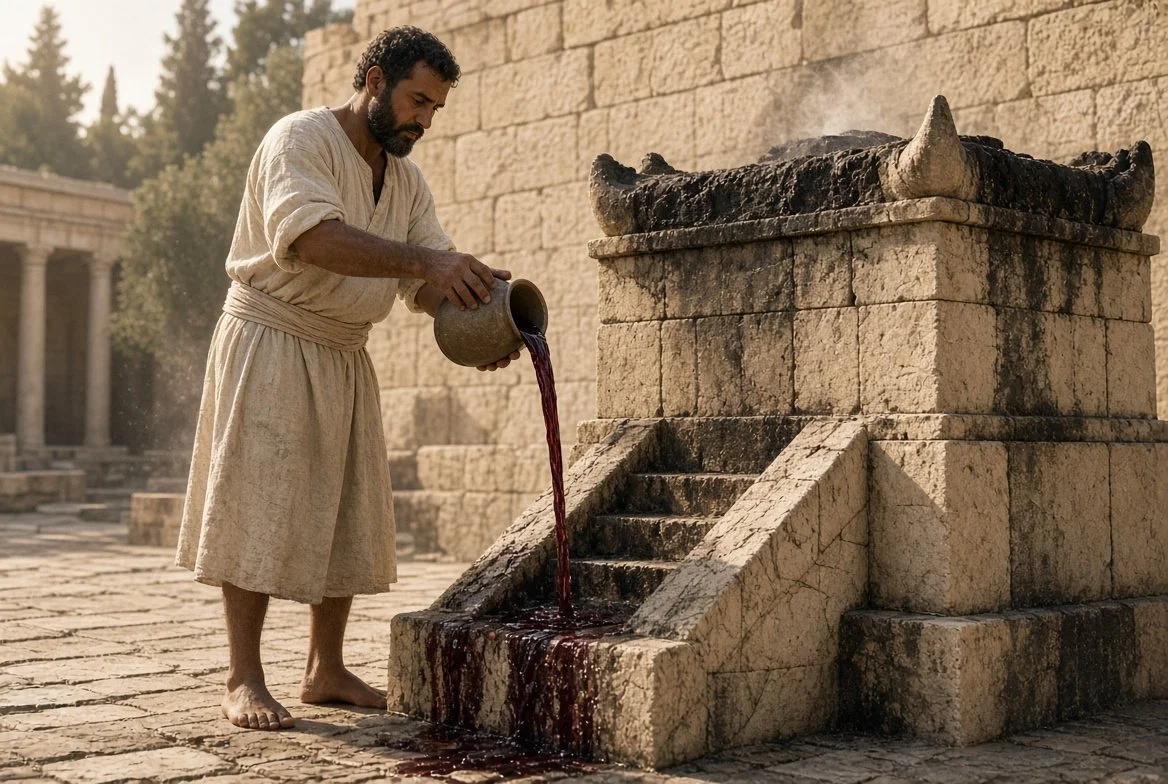
In the Levitical system, the drink offering held a consistent and distinctive place. It was always poured out completely, never drunk by the priests or the people as part of the ritual.
The drink offering of wine accompanied the daily burnt offerings, grain offerings, and many of the appointed feasts. Every morning and evening, with the sacrifice of a lamb, a quarter hin of wine (about one quart) was poured out at the base of the altar (Exodus 29:40-41; Numbers 28:7). Larger offerings required more: a third of a hin with a ram, and half a hin with a bull (Numbers 15:4-10).
This pouring expressed total devotion and joy offered upward to the Lord. It was part of the “soothing aroma” that rose to God, symbolizing complete surrender. The wine was expended, given entirely, as the people of Aaron’s line approached a holy God through the sacrifices.
The Prophesied New Priesthood
The Law and the Prophets themselves announced that this order would not stand unchanged forever. God warned Eli’s house that the priesthood would be stripped from it and given to a faithful priest who would serve according to God’s own heart (1 Samuel 2:27-36). Psalm 110 declared a coming Priest-King: “You are a priest forever after the order of Melchizedek.”
This shift was lawful and written into the covenant from within.
Returning to Abraham’s Line
Aaron came through the lineage of Abraham. So it is important to return to the foundational encounter between Abraham and Melchizedek (Genesis 14:18-20).
In that meeting, two significant realities appear that point forward:
Abraham gave tithes (a tenth) to Melchizedek, acknowledging the greater priesthood.
Melchizedek brought out bread and wine and gave them to Abraham, who received and partook.
Here, in the presence of the prophetic priest-king, Abraham (the father of the line that would produce Aaron and the Levitical priests) drank the wine. This event pointed forward to the greater priesthood and the symbol of its service.
The Contrast: Poured Out vs. Received
Abraham’s descendants, under the Aaronic order, poured out the drink offering. The wine was given entirely to the Lord at the altar, a beautiful and necessary act under that priesthood.
But Christ, the promised seed of Abraham and High Priest after the order of Melchizedek, brings the greater reality. At the Last Supper, Jesus took the cup and said:
“Drink from it, all of you. This is my blood of the new covenant, poured out for many for the forgiveness of sins.” (Matthew 26:27-28)
The wine that was poured out in the Levitical system is now also received and drunk by the new priestly people. What was expended at the altar finds its fullness in the One who both offers the perfect sacrifice and invites His people to partake of its benefits.
This is the beautiful distinction between the two priesthoods:
In the Aaronic order (Abraham’s natural line), the drink offering was poured out.
In the Melchizedek order (fulfilled in Christ), the wine is poured out on the cross and received at the table.
All believers in Christ are now made “a royal priesthood” (1 Peter 2:9). We sit at the table of the greater Priest, drinking the cup of the new covenant.
The old patterns are not discarded, they are honored and brought to their intended completion. Every stroke of the Law stands, and the prophecies spoken at the Melchizedek-Abraham meeting find their living expression in Jesus.
Blessings,
William

The Conscience That Still Aches
There is a strange mercy in a conscience that still remembers. Many believers live in the quiet tension between forgiveness and the lingering ache of past failure.
There is a strange mercy in a conscience that still remembers.
Many believers live inside a quiet tension. They know the gospel declares them forgiven, yet the memory of past failure still rises with an ache. Others notice the opposite: the ache has grown faint, and they wonder whether something essential has gone numb. Both experiences are more common than most people admit. Both deserve to be met with honesty and care rather than slogans.
The Biblical Witness
Scripture never treats the conscience as frozen in place. It can be clear or defiled, tender or hardened, pure or seared. The striking image of a conscience “seared” as with a hot iron appears only once (1 Timothy 4:2), yet it stands within a much longer biblical story of progressive resistance. Hearts grow heavy. Necks stiffen. Ears become dull. The capacity to feel the weight of sin can diminish when it is repeatedly ignored.
At the same time, Scripture speaks of a conscience that remains alive toward God: an inner witness still capable of remorse, repentance, and the fear of the Lord. A living conscience feels. When that capacity is lost, something grave has occurred.

The Apostle Who Remembered
Paul stands at the center of this tension. He never stopped calling himself the foremost of sinners. The memory of his violence against the church remained vivid enough to shape his self-understanding years later. Yet the same man could say that he served God with a clear conscience.
He is also the one who warned Timothy about people whose consciences had been seared. The contrast is not theoretical. Paul knew, from the inside, the difference between a conscience that still felt the weight of past evil and a conscience that no longer registered it at all.
That knowledge was not abstract. Paul repeatedly returned to cities and synagogues where he had once arrested, imprisoned, and harmed believers. He stood and preached the name he had tried to destroy, sometimes to people who would have known exactly who he had been. The geography of his former life was not erased. He walked back into it. The residual weight of what he had done went with him, and still he preached Christ.
Here the distinction becomes clear. The court of heaven does not pretend the believer’s sin was never guilty. The verdict over the sin remains guilty. What changes is that the full penalty has already been borne by Christ. The debt is not dismissed; it is paid. A conscience that keeps trying to reopen the case and pay again has missed the finality of the cross. A conscience that remembers the guilt and the cost, yet rests in the payment, has understood it.
Two Real Dangers
On one side is the danger of growing remorseless. When a person can look at clear and serious harm they have caused and feel no genuine grief, Scripture treats that loss of sensation as a warning. Not every quiet season of the soul is searing, and emotional intensity is no perfect measure of spiritual health. Still, the complete absence of moral pain after real injury is not a sign of maturity.
On the other side is the danger of endless self-reproach. Many sincere believers live under a low-grade verdict of their own making. They rehearse what has already been borne by Christ as though further emotional payment were still required. The result is not deeper holiness but exhaustion.
Both distortions leave the conscience malformed: one by numbness, the other by unrelenting accusation.
The Ordinary Weight of Memory
Moral pain often has a bodily and emotional dimension. The ache that lingers, the heaviness that rises unbidden, the sharp recollection of failure, these are common human experiences. They do not need to be treated as design flaws or as proof of incomplete forgiveness. In their proper place they can serve as a safeguard, much like the memory of a burned hand keeps a person from touching the stove again. The same feelings can also turn corrosive when they become a form of self-punishment. The difference lies in whether the memory drives a person back to the finished work of Christ and into watchfulness, or into isolation and despair.
A Word to Those Who Struggle
If your conscience still wounds you over sins long confessed and forgiven, you are not alone. Many believers carry the same tension. The presence of that ache does not automatically mean you remain condemned. If it leads you to greater humility and dependence on Christ rather than to self-hatred, it may be serving as a guardian rather than a judge. You are not required to achieve a state of perfect self-forgiveness for God’s verdict to stand. The verdict rests on Christ.
If you feel little or nothing when you consider past or present sin, do not take quick comfort in the absence of pain. Ask the Spirit to keep your conscience tender. The goal is not permanent emotional intensity, nor is it a casual familiarity with the cross that shrugs and says, “God has to forgive me anyway.” It is a living sensitivity to the holiness of God and the real cost of the cross, one that keeps a person from treating grace as permission while still resting fully in the payment Christ has already made.
The Aim
The aim is neither numbness nor endless self-reproach. It is a conscience cleansed by the blood of Christ and kept alive by the Spirit, able to remember the gravity of sin without denying the finality of the payment. Such a conscience is not a burden. It is one of the quiet ways the Lord keeps His people from returning to the same fire that once burned them.
That is the strange mercy of a conscience that still aches.
Find the ancient paths. The Lord who died for our sins counted us worthy of the cost.
Blessings,
William