The church already knows something is wrong with the word defense.
In one place it means argument and branding, as if God needed the congregation to keep Him standing. In another place it means putting the armor down, as if speaking were unbelief and silence were humility. Both sides can quote a verse. Most people, if they are honest, will admit the word is confused on every side.
This series exists because that confusion is a real problem in the church. Passion has not fixed it. Passion without knowledge of the Scriptures does not put anyone back in their proper place. It only makes them louder while they stand where they do not belong.
Scripture has already shown how that happens.
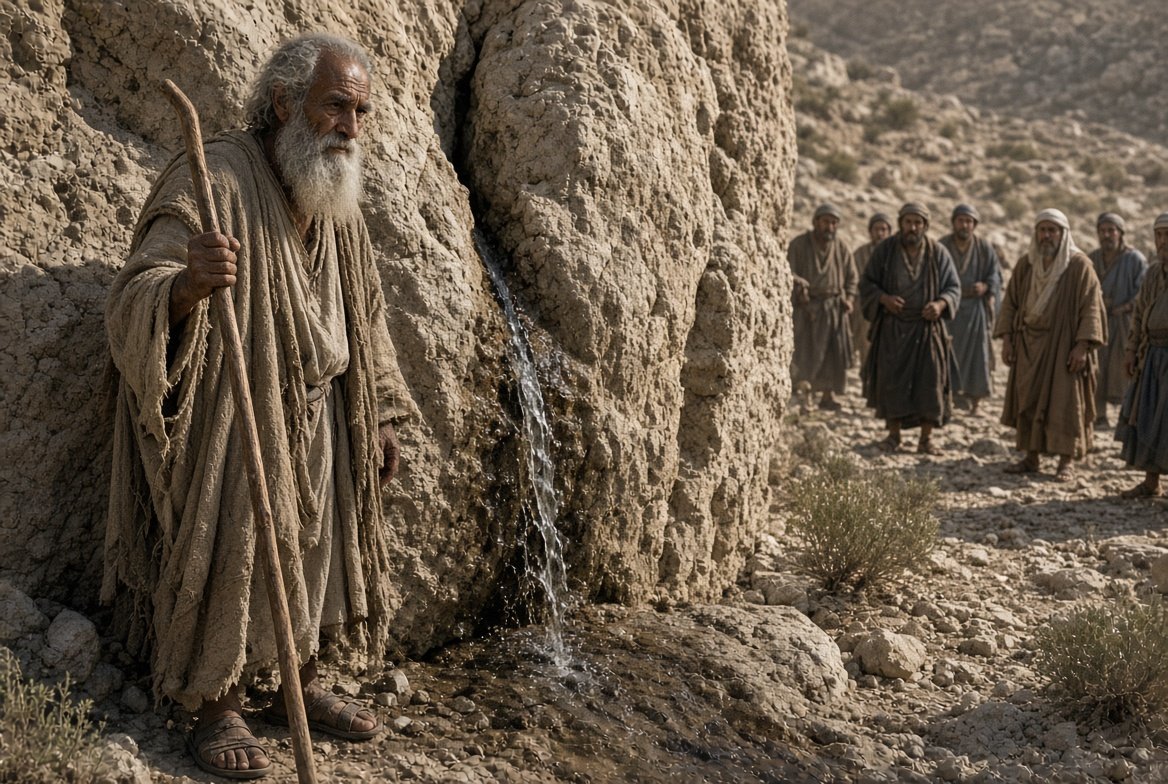
In the wilderness the people had no water. The Lord told Moses to take the rod, gather the assembly, and speak to the rock. Water would come. God would give it. God’s name would be honored in front of the people. Moses gathered them and took the rod. Then he said what he had not been told to say: “Listen now, you rebels, must we fetch you water out of this rock?” He struck the rock twice. Water came. Moses replaced God’s authority with his own. The Lord still loved him. He was still God’s servant. He was still the prophet. Yet he was told he would not bring the people into the land, because he did not believe the Lord enough to honor Him as holy in their sight.
That judgment does not mean Moses stopped belonging to God. It shows what the moment was. Holding the rod did not make God’s power his. When he said, “must we fetch,” he spoke as if he and Aaron were the ones providing what only God provides. The water was God’s. The honor of the Name was God’s. That one sentence put Moses in God’s place.
That account is not only about the wilderness. It describes a kind of Christian speech. “Must we fetch the truth for you?” is the same sentence in another setting. It can be said with zeal, from a pulpit, online, in a debate, or in a comment. It can sound like defending the gospel. It still treats God as if the truth had to be produced by us.
The knowledge Scripture commands is not a degree and not a personality. It is staying where we belong: God holds the power; His people serve Him; they are told to know Him, to think on what He has said, and to learn what He has commanded. That kind of knowledge keeps a person in humbleness. Lack of it does not prove they were never His. It only proves they can still strike the rock as if the power were theirs.
This series is not written to take charge of the church. It is written to start a conversation that returns to Scripture; speech about God that stays with what He has said, and that talks without replacing listening. Too many Christian writers avoid that kind of conversation. A piece that is afraid of questions has already decided it must not be examined. Scripture can be examined. A private brand often cannot.
So this first part will not define every Greek word. It will not yet walk through Paul in prison, or the shield and the sword. Those come later. This part is simpler:
Come back to the table.
Stop talking over God.
Start listening again.
Let Him show what defense looks like.
The knowledge we need is already in the Bible. We can talk. We should talk, speak, discuss, and answer error. We cannot replace listening with a pile of eager words that never sat under what is written. Speech like that is only “must we fetch” with more words.
An honest reader can enter that conversation without giving up who they are in Christ. Nothing here asks anyone to stop belonging to Him, to stop loving the gospel, or to stop speaking. It asks them to let the written word set the terms. A person who needs the performance itself to be the ministry will resist that. If the knowledge is in Scripture, the performance is not the authority. “We can’t do that” is not an answer to Moses. It is a refusal to put the rod down.
This series is for the reader who will follow the whole line of Scripture. It is not written to catch the person who only looks for a line that blesses what they already do. It is not written to change the person who wants to look like the one who makes hell shake. Those people will still be in the church when the last part is posted. The aim here is to set out what Scripture actually teaches about defense.
What follows will keep Paul’s words - “the defense of the gospel” - and will not change Paul’s meaning to suit a preference. It will read his meaning within the rest of Scripture. God is the shield and the defender and His people are the ones He defends. We are told to: speak as witnesses, humble ourselves under His hand because the devil still looks for someone to devour, hold up the same word as our covering, and use that word when a false spirit is at work among us. It will not treat Paul and Peter as if they taught two different things. It will not pretend both current church habits are equally faithful. The split in the church is real. Scripture does not teach both habits.
That is why this series is needed. The church leaves its proper work when it talks over God and then calls that faithfulness. What needs to happen is simpler than another campaign. The people return: not to produce the water, but to hear the One who still gives it, and to speak only after they have listened.
The ancient paths await. Find them.
William