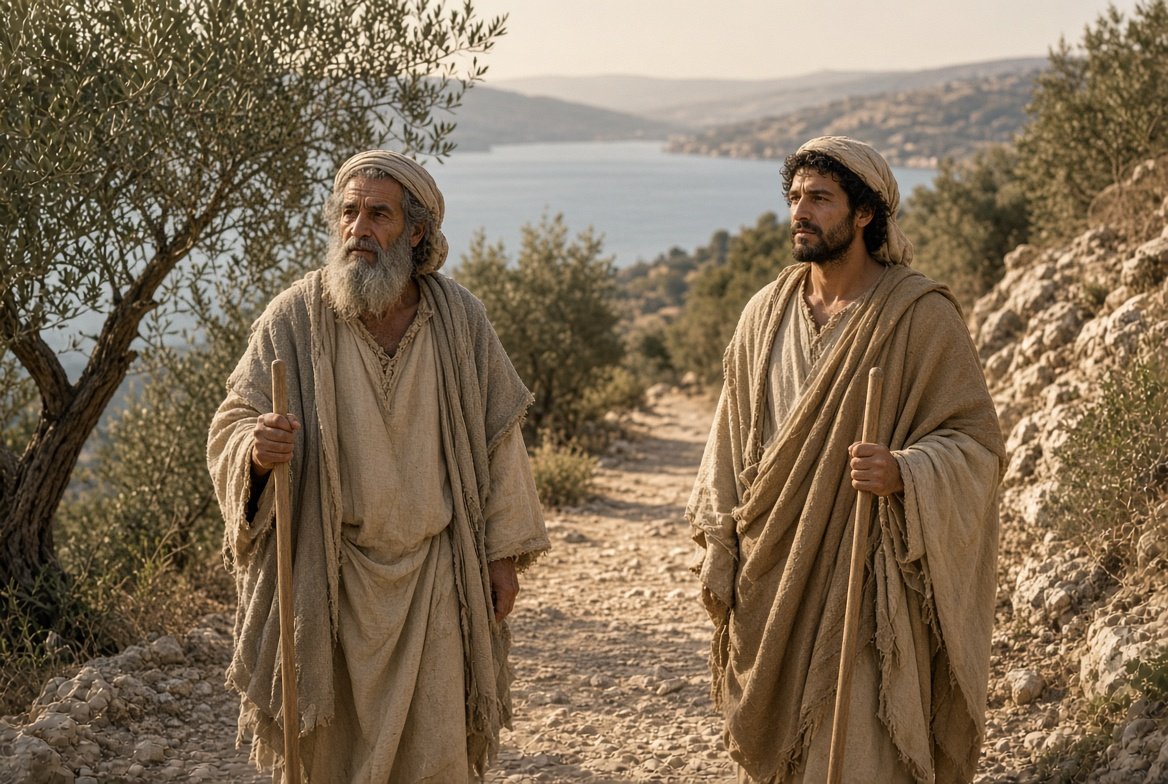
Paul and Peter taught the same thing.
This truth needs to be said without decoration. The church often prefers one apostle when a temperament needs cover. One reader wants chains, argument, and a man posted at a trial. Another wants gentleness, hope, and a quiet heart. Scripture gives both. It does not give them as two gospels. It gives them as one defense, lived from two posts and two moments inside the same struggle.
Paul is in prison when he speaks of the defense of the gospel. He is not roaming as God’s bodyguard. He has been put there. Commanded to be there. The word he uses for his place can carry the sense of a man stationed for a duty. Guards stand outside the door. He stands inside it for another reason. Some preach Christ from envy, hoping to add affliction to his chains. Others preach from love, knowing why he is there. He can rejoice either way because Christ is preached. That is not indifference. It is a man who knows the gospel is not his possession to protect. He is the witness. The word goes out even when the witness is bound.
His education belongs in that picture, and it belongs there carefully. Paul knew the writings. He knew the traditions he had left. He knew how to answer a magistrate and how to answer a synagogue. That knowledge did not make him the source of the water. It kept him from taking a seat that was not his. An untrained passion can strike the rock and say, “must we fetch.” A restrained and educated man can do the same thing with better sentences. Paul does not speak from that unrestraint. He gives an account. He confirms what has already been given. He does not produce a second gospel, or a personal brand, to win the room.
Peter writes to people who have already been scattered. They are not in a Roman hall. They are in households, workplaces, and towns where a question can come because of the way they live. He tells them to set apart Christ as Lord in their hearts. The account they give is of a hope already there, not of a system they must invent under pressure. He tells them to give it with gentleness and respect, keeping a clear conscience. He also tells them to humble themselves under the mighty hand of God, casting their anxiety on Him, because the adversary prowls like a lion and looks for someone to devour. The devourer is not a metaphor for losing an argument. He is the reason humility is not optional. A man who steps out from under God’s hand to become the champion is the man the lion can take. A man who stays under that hand can still speak.
Those are not competing instructions. Peter does not say, be silent so that you may be humble. Paul does not say, be harsh so that you may be faithful. One is posted in chains and gives a defense. The other is scattered and must be ready to give an account. Both keep Christ as Lord. Both refuse the throne. A mother once asked that her two sons sit at the right hand and the left. Jesus did not grant the seats. Paul and Peter do not take them either.
Jesus is the pattern they are following, not a third school. When the adversary pressed Him in the wilderness, He did not match insult with insult. He said, “It is written,” and He said it from the writings the adversary was trying to bend. When He was questioned in the temple, He answered from the same book. The shield moves when the word is spoken. The speaker does not become the vinedresser. The cut, when there is a cut, belongs to God.
Antioch will be walked in the next part because it shows the sword. It belongs here only as proof that the two men are not brands. Paul opposes Peter to his face when Peter’s conduct is not in step with the truth of the gospel. He does not unmake Peter. He does not found a party. Peter remains an apostle. Later, Peter calls Paul’s letters Scripture, and says some things in them are hard to understand, which the unstable twist. If they had taught two religions of defense, that sentence cannot stand. A man does not hand the church the letters of a rival gospel and call them Scripture.
This is why a favorite apostle is another stolen staff. Keep Paul’s defense and drop Peter’s humility, and the church gets a warrior. Keep Peter’s gentleness and drop Paul’s willingness to name a false spirit at the table, and the church gets a silence that calls itself peace. Neither is the view they taught. They stood in one defense, as foot soldiers under command, not as commanders of the Lord’s army. The difference was the room, and the struggle in front of them.
The last paper in this series will have to stand the same way. Not “must we fetch a new priesthood.” Not “must we fetch a canceled Moses.” Open the page. Let the writings already given do the work. Paul and Peter are the method, not the source. Christ is Lord in the heart before the account is given. God remains the shield. The servant speaks what is written, and then he stays under the hand.
Find the ancient paths, where education and humility stay under the hand.
William