When the Church Takes Its Eyes Off Christ
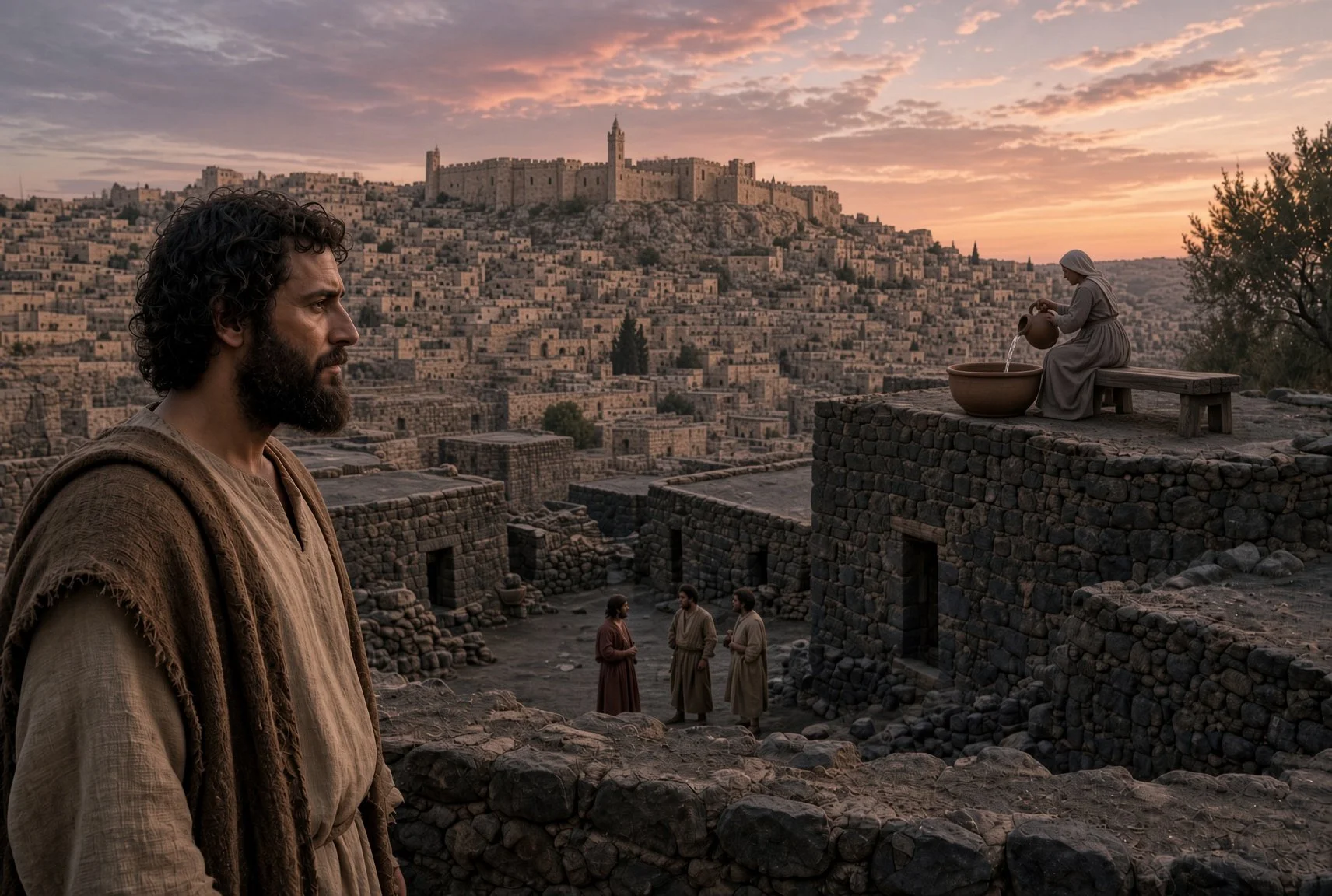
It is easy to shake the head at David on the roof. It is easy to quote Nathan: “You are the man!” The line preaches well because the villain is already dead and the prophet has already won. The question that still matters is the one the story is actually asking:
Why did it happen, and why does the same pattern keep happening among people who know the story by heart?
Scripture’s answer is not a theory about roofs. It is a fact about eyes. The king’s circle had learned to watch the anointed man more carefully than they watched the Lord who had anointed him King. That is how a private evening becomes a public wound. That is how a court that can quote the commandments still cannot say a sentence that would cost it the favor of the throne.
Watch the verbs. David sees. David sends. David inquires. David takes. David lies with her. David sends again, this time for the husband, and when the husband will not go home to cover the king’s shame, David writes the letter that kills him and puts it in the husband’s own hand. Joab receives the letter and carries out the order. The report comes back dressed as the fortunes of war. Bathsheba mourns. Then she is brought into the house. The child is conceived in secret and born in the open, and for a little while it appears that the rooftop choice has gotten away with itself.
The guilty verbs sit squarely upon the king. Nathan’s parable does not split the indictment. “You are the man” is singular. Matthew later names Bathsheba in Messiah’s line as “her of Uriah,” a phrase that remembers the murdered husband, not a footnote of her shame.
What the narrative lingers on is the silence around him. Joab is no coward. He had argued with David about censuses and tactics. On this day he obeys a murder. The palace manages a pregnancy. Uriah sleeps at the door of the king with the ark still in the field, and his loyalty becomes the tool that kills him. No one in that inner ring walks the length of the courtyard and says the thing that would have stopped the letter. The prophet who finally does say it has to be sent by the Lord from outside the circle that ate at David’s table. By then the husband is in the grave. The cover-up has already taught the palace what it will tolerate.
David himself had once known a holier use of the same instinct. In the cave he would not put a hand on Saul, because Saul was the Lord’s anointed. He said it aloud. He restrained the men who would have finished the matter for him. The phrase was obedience then. In his own reign it became a muzzle. The court that learned “do not touch the Lord’s anointed” from David’s mouth learned also not to touch David with the truth. A sentence that once protected a fallen king from vengeance now protected a living king from repentance.
The Lord did not treat that as a private embarrassment. “The sword shall never depart from your house,” Nathan says, “because you have despised Me” (2 Samuel 12:10). The word is aimed at David, and the house is the unit that bleeds. The child dies. Amnon violates Tamar and is killed for it. Absalom waits, steals the hearts of Israel, and drives his father barefoot out of the city which David had taken from the Jebusites. On the day the rebellion breaks, “there was a great slaughter that day of twenty thousand men” (2 Samuel 18:7). The oak, the darts, and the pit are only the end of a road that began when the king stayed home in the season when kings go out, and when the men who loved him loved his favor more than his soul.
A wound opened in the house of the Lord’s anointed was never fully closed. A people who had learned to fear the king more than the Word of God kept paying for that education long after the king was in his tomb.
The pattern does not require a crown.
John meets it in a man who “loves to be first,” who will not receive the apostle and who puts brothers out of the church (3 John 9-10). Diotrephes is not named because he is loud. He is named because the church around him lets him be first. Someone has already decided that peace with the man is safer than fidelity to the letter John had written. That is not a different sin from Joab’s. It is the same silence in a smaller room. Naming that spirit is not schism. John already named it. The test has not changed: does this love to be first, or does this keep the eyes of the flock on Christ?
Scripture has been drawing that contrast for a long time. A bride either keeps herself for the Bridegroom, or she runs after whatever promises greatness. A shepherd stays with the sheep when the wolf comes, or he is a hireling who watches the door of his own life. A church speaks while the walk to the roof is still only a walk, or it learns the palace skill of silence and calls the silence unity. Those contrasts exist in Hosea and Ezekiel, in John 10 and 3 John, in the last chapters of Revelation. The names of the columns do not matter. Which column God’s people occupy does.
Nathan’s walk across the courtyard is still the antidote, and it is still costly.
Keep the eyes on Jesus, the Author and Perfecter of the faith, not on the man who currently holds the staff or the pulpit.
Speak the truth in love while the roof is still only a roof. After the letter has been sent, the prophet can still come. He comes then to a grave.
Hold every leader up against the text he is meant to serve. “Do not touch the Lord’s anointed” is not a command to stop telling the truth.
Examine the heart before the Lord’s Table. That table exists because only one Man is worthy of preeminence. The bread and the cup will not bless a church that has quietly seated another man in His place.
The point is not terror. It is gospel. Only one Man was willing to become sin and bear reproach outside the camp so that the rest could be cleansed (Hebrews 13:12-13). The stories expose the house so that the blood of Jesus can cover the house. If that truth unsettles the reader, the right run is not into a defense of the court. It is to the One who was crucified outside the gate.
These accounts are not museum pieces about a king who stayed home in the spring, or about a loud man in Asia Minor who would not receive John. They are a mirror for all of us. If the next chapter were written about the churches now living, which column would it record: the bride who keeps herself for the Bridegroom, or the people who cannot bear to leave the court of a man?
And if the king is on the roof, and the end of that walk is already written in a book everyone claims to love, then for the love of God, and of the people who will have to live with the silence, say something.
Find the ancient paths and your voice of truth.
William