The Galilee Gazette – Issue #43
By your humble correspondent in Jerusalem, the fourteenth day of Nisan in the fifteenth year of Tiberius
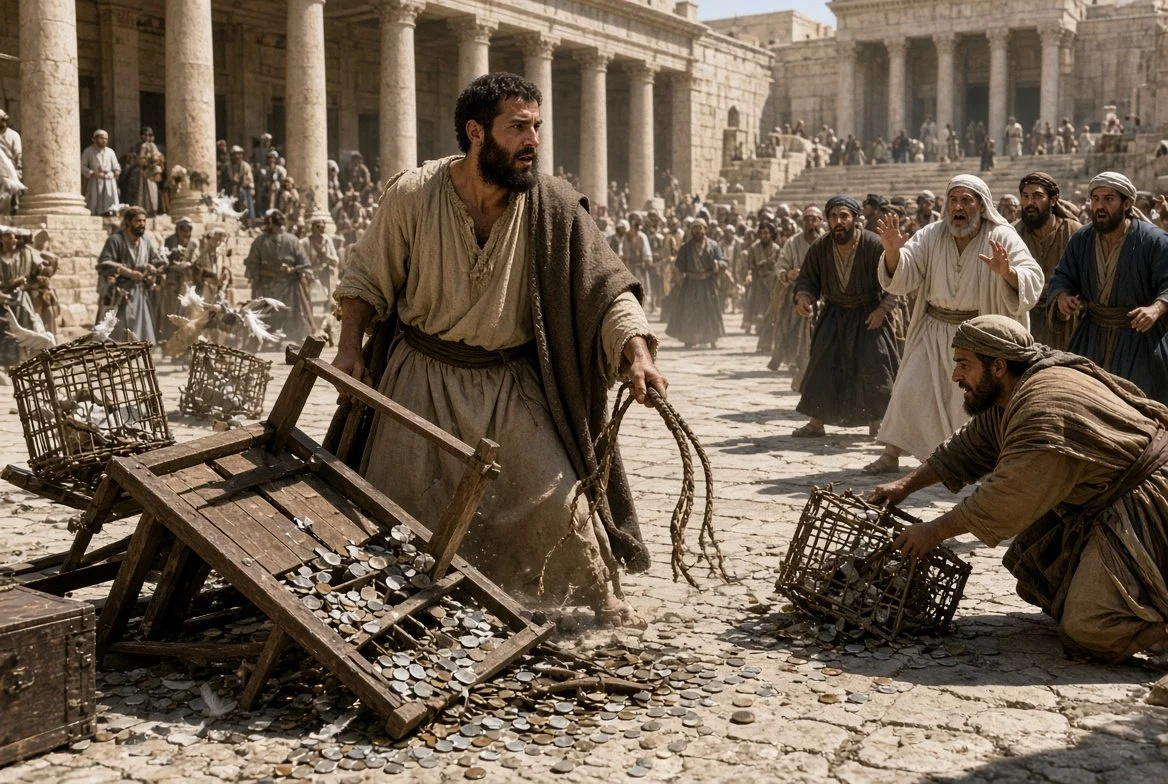
Jerusalem’s outer court, the only stretch of the Temple Mount where a Gentile could stand without risking death, turned into a livestock market and currency exchange this morning. A Galilean named Yeshua of Nazareth walked in, plaited a whip of cords, and drove the sellers and buyers out. He overturned the tables of the money-changers and the seats of those selling doves. Coins of every stamp skittered across the stone. Among them lay a silver denarius, face up: the laureate head of Tiberius and the legend that called him son of the divine Augustus. A pair of Sadducees, men who measured the Temple’s strength in gold and the favor of Rome, stared at the scattered image as if the floor itself had turned traitor. Birds beat upward. For a stretch of time Yeshua would not let anyone carry a vessel through the court.
He taught while the dust settled. “Is it not written,” he said, “‘My house shall be called a house of prayer for all the nations’? But you have made it a den of robbers.” The chief priests and scribes heard it and began looking for a way to destroy him. They feared the crowd, which was astonished at his teaching. By evening he and his followers left the city.
The outer court had long functioned as a practical convenience. Pilgrims arrived with foreign coin and needed the Tyrian half-shekel accepted for the temple tax. Many also needed an approved animal. Josephus notes that the outer enclosure was open to foreigners (only menstruating women were barred from it), while a low balustrade farther in carried the warning, in Greek and Latin, that any non-Jew who crossed it would have only himself to blame for his death. What had begun as accommodation had become congestion. The space meant for prayer by the nations was filled with bargaining, cages, and the clink of exchange.
The high-priestly families, particularly those connected to the house of Annas, controlled the stalls. Prices for doves, the offering of the poor, could be driven high enough that later rabbinic memory still records a sharp reduction when one of the Gamaliel line intervened. The temple itself held vast deposits. Josephus describes the vaults serving as a kind of central safe for coin from across the empire. Commerce and sacred space had merged under patronage.
The Galilean’s action was public and therefore an honor challenge. He did not merely complain. He stopped the traffic. The phrase he used, “den of robbers,” comes from Jeremiah’s temple sermon. The place had become a hideout where people who practiced injustice could feel secure after the fact. Isaiah’s promise that the house would be a house of prayer for all nations was being squeezed by the very traffic that was supposed to serve worshipers.
Cultural Shocks Most Modern Readers Miss
The outer court was the only legal place Gentiles could pray. Turning it into a marketplace did not just annoy. It blocked the one space the architecture had left open to the nations.
The required coin was the Tyrian shekel. It carried the image of Melqart. Worshipers exchanged imperial or local money for a coin stamped with a foreign god in order to pay the temple tax.
High-priestly patronage ran the concessions. The stalls were not a free market of independent traders. They were controlled by the families who also controlled the sanctuary. Profit and priesthood sat at the same tables.
“Den of robbers” is a hideout, not a theft in progress. Jeremiah (and Jesus after him) described the temple as the place people retreated to after injustice, confident the building itself would cover them. The problem was not only the exchange rates. It was the assumption that sacred geography made the rest of life safe.
Biblical Shocking Takeaway
The house was never meant to be a private franchise. It was written as a house of prayer for all the nations, and the one who drove the tables over treated that writing as still in force.
If the outer court were the only place the outsider could actually pray, what tables in a modern community would have to be overturned before that prayer could happen?
© 2025–2026 Galilee Publications
Rush the shores, where our Lord reveals the corrupt and the thief.