ANTIOCH DAILY – Issue #44
By your humble correspondent in Antioch, on the fourth day of the week, in the month of Nisan, fourteenth year of Tiberius Caesar
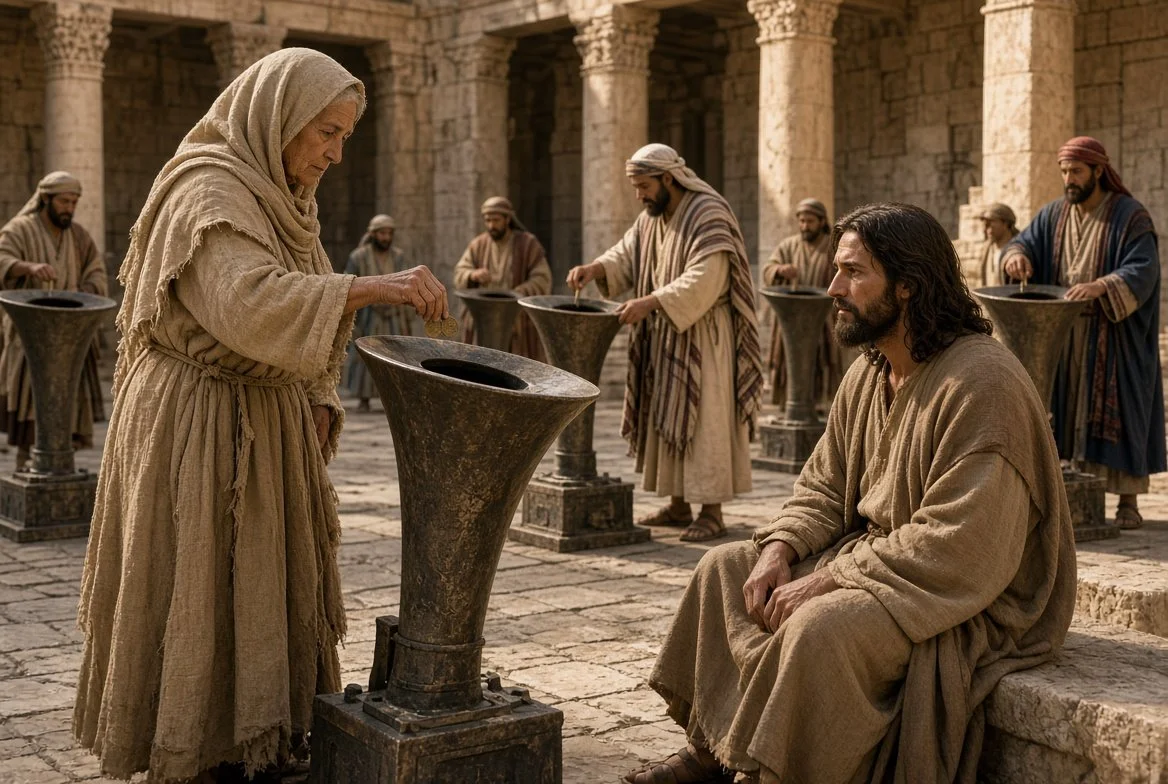
The clatter never stops in the Court of the Women. Thirteen trumpet-shaped chests stand against the colonnade: narrow mouths, wide bellies, built so every coin rings when it drops. Rich men from the Upper City step forward in full view. Their silver and gold cascade with a satisfying roar. Heads turn. Honor is collected along with the offering.
Then a widow approaches. No one turns. She opens a small cloth and lets two lepta fall. The sound is almost nothing: two tiny bronze discs, the smallest coins still circulating from the old Hasmonean mints, together worth a single quadrans. She has nothing left.
Jesus of Nazareth, seated opposite the treasury, watches the entire parade. He calls his disciples over and says the quiet thing that empties the room: this woman has put in more than all the others. They gave from what they could spare. She gave from her poverty…her whole living.
Philo of Alexandria once wrote that the Temple’s revenues would endure as long as the human race itself, co-eternal with the universe, because the half-shekel and the freewill gifts never cease. Josephus later described the treasury chambers that burned in 70 as the place “where the entire riches of the Jews were heaped up together.” The contrast is sharp enough to cut. The same institution that collects the world also receives the last two coins of a woman who will eat nothing tomorrow.
Cultural Shocks Most Modern Readers Miss
The chests were deliberately shaped like shofars so offerings announced themselves. Giving was public theater. The rich performed generosity; the poor disappeared into the noise.
Two lepta equaled roughly one sixty-fourth of a denarius. A day laborer earned a denarius. The widow’s gift was less than fifteen minutes of ordinary work and it was everything she possessed.
Under prevailing inheritance practice a widow’s security ended when her husband died. Property passed to sons. The scribes Jesus had just condemned for “devouring widows’ houses” were not abstract villains; they were the people who administered the very system now receiving her last coins.
Aristotle, writing centuries earlier, observed that “it is quite possible that the giver of the smaller sum may be the more liberal man, if his means be smaller.” The Galilean teacher applied the same arithmetic inside the Court of the Women, then walked out and declared that not one stone of the place would remain on another.
Biblical Shocking Takeaway
God does not count what is left over. He counts what is left of the giver.
Reader Discussion Prompt
If the size of the gift is measured by what it costs the giver rather than what it adds to the treasury, what does that do to the way we keep score?
Note: Recent archaeological work on Hasmonean prutot continues to confirm that these tiny bronze coins remained in circulation well into the first century, exactly as the Gospels describe.
© 2025–2026 Galilee Publications.
Rush the shores. Where your little is acknowledged and proclaimed great by God.