LAWYER ASKS WHICH COMMANDMENT WINS. GALILEAN COLLAPSES THE WHOLE TORAH INTO TWO LINES. TEMPLE SMOKE STILL RISING.
THE JERUSALEM SCROLL Galilee Publications – Issue #38
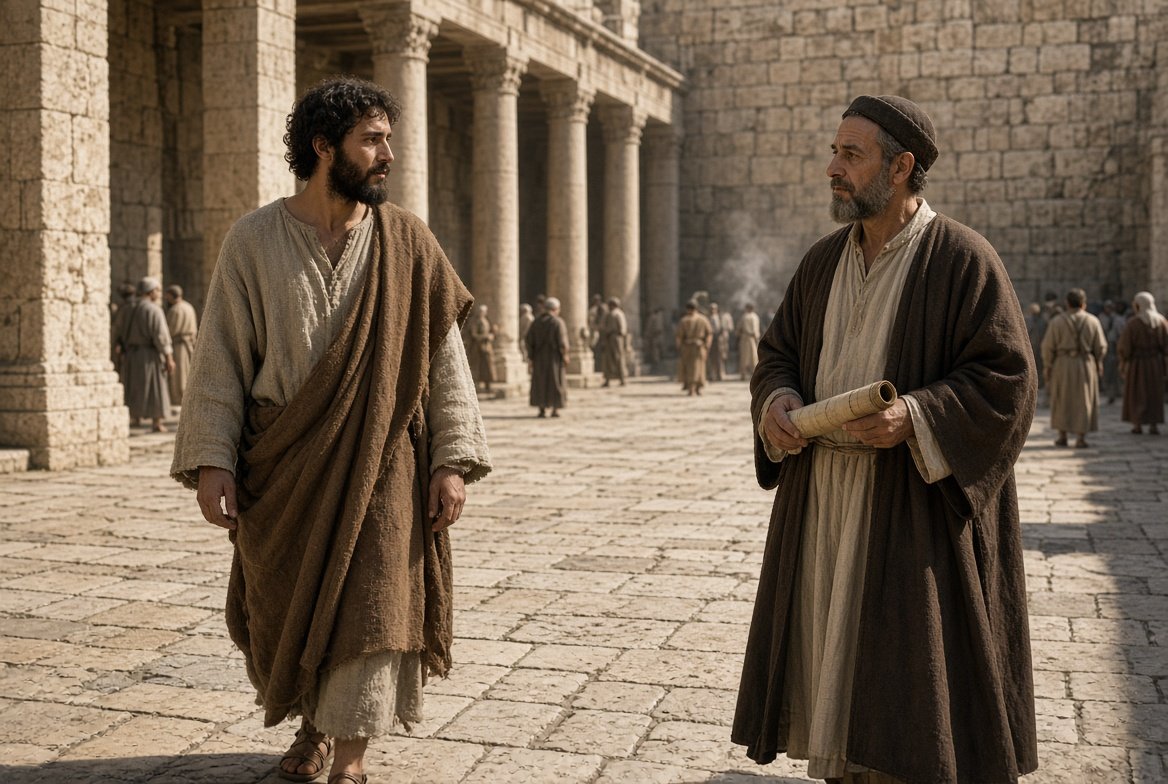
By your humble correspondent in Jerusalem, third day after the great entry, in the week of Unleavened Bread
A scribe of the law, one of the men who can quote you the weight of a tithe of mint before breakfast, stood in the Temple courts this week and asked the Galilean a question that has kept legal minds happily employed for generations:
Which commandment is first of all?
He had just watched the same teacher flatten the Sadducees on the resurrection. The man was, by local standards, having a good morning. So the lawyer did what lawyers do. He asked for a ranking.
The Galilean did not produce a scroll. He did not convene a subcommittee. He recited the line every Israelite already says twice a day:
Hear, O Israel: the Lord our God, the Lord is one. And you shall love the Lord your God with all your heart, and with all your soul, and with all your mind, and with all your strength.
Then, without pausing for applause, he added the verse from Leviticus that polite society prefers to keep in the “neighborly advice” column:
You shall love your neighbor as yourself.
No other commandment, he said, is greater than these.
The scribe, this is the part that will be argued in the porticoes until the next new moon, agreed.
Worse: he improved the answer. Love of God and neighbor, he said, is much more than all whole burnt offerings and sacrifices.
He said this in the Temple.
While the smoke was still going up.
While the money-changers were still counting.
While the animals that exist to become “much more than” were still making the noise animals make when they suspect the afternoon schedule.
The Galilean looked at him and delivered the most dangerous compliment currently circulating in Judea:
“You are not far from the kingdom of God.”
Not in. Not arrived. Not far.
In honor-shame culture, which is the verbal equivalent of being told you almost made the guest list.
After that, Mark records, no one dared ask him any more questions. The professional question-askers had, for one afternoon, run out of questions.
Philo of Alexandria, who never met a twofold division he could not baptize in Greek, had already written that the two tables of the law are incomplete without each other: piety toward God on one side, justice toward neighbor on the other. Take either half away, he said, and the thing collapses. The Galilean and the scribe simply said it in the courtyard instead of the study.
Cultural Shocks Most Modern Readers Miss
Ranking the 613 was a live sport. Later tradition would count 365 “don’ts” and 248 “dos.” First-century scribes already argued which commands were “heavy” and which were “light.” Jesus refused the bracket. He did not pick a winner among the many. He named the two from which the many hang.
The Shema was not a trivia answer. It was the twice-daily creed, bound on the arm and the doorpost. Using it as the “greatest commandment” was like answering “What is the most important American idea?” with the Pledge of Allegiance and then adding “and also stop treating the person next to you like inventory.”
“Better than burnt offerings” is a Temple grenade. Hosea and the psalms had said it for centuries. Saying it on site, with the altar operational, is the difference between quoting a critic of Wall Street and quoting him on the trading floor.
A scribe agreeing with Jesus is the actual news. Mark’s Gospel is not shy about hostile lawyers. This one hears well, answers well, and is told he is close. The shock is not that Jesus loves the law. The shock is that the law, rightly heard, loves him back.
The kingdom is not far from the person who discovers that God never asked for a longer list. He asked for a whole heart and the neighbor who comes with it.
If the two commands really hold the rest, which of your current religious habits would survive a week with no Temple smoke and no audience?
© 2025–2026 Galilee Publications
Rush the shores. Leave the ranking at home and you might find the kingdom.