Issue #3
The first days have already done their work. Light has been spoken. Waters have been gathered. Dry land has appeared. Living things have come, each according to its kind. The week has not rushed. The world has been made ready.
Then the wording changes. God does not only say, “Let there be.” God says, “Let us make man in our image, after our likeness.” Before any dust is taken, the man is spoken of. He is not an afterthought in an empty world. He is announced, then formed.
The image as a given task
The image is not a drawing of God’s body. It is a charge. The One who made the world sets a steward in it. Dominion in this chapter is not permission to strip the earth. It is care of what exists. Rule is given the same way breath will be given: from God, toward a world already called good.
So God created man in the image of God. Male and female He created them. One image. Two, given together. The blessing is spoken over both: be fruitful, fill the earth, subdue it, and rule over the fish, the birds, and every living thing that moves. The earlier days now have a caretaker. Not an owner. A caretaker.
None of this is earned. The image is not a prize for strength or skill. It is given to dust that has not yet opened its eyes.
Dust and breath
Genesis 2 slows down so the making can be seen. The Lord God formed the man of dust from the ground and breathed into his nostrils the breath of life, and the man became a living soul.
Dust comes first. The man is from the ground, not above it. The soil that will feed him is the same soil taken into God’s hands. There is no self-made man here. There is clay.
Then breath. Life does not rise from the dirt by waiting. It is given. Animals already live in the fifth and sixth days. Then the man is formed. Many now describe that same order in their own words. Moses wrote it first, as story, not as a modern claim. How did he see it? Who told him?
The story does not stop to win the point. It needs the man last for another reason. He did not make the beasts. He is set over a world already stocked.
What is given to him is personal: breath from God, a voice that can answer, names for the animals, a calling to keep a place. Gift on gift. Not a ladder he climbed. Genesis does not flatter him. The dust was taken in hand. Breath was given. He made none of it. He is precious because he was received.
A garden planted
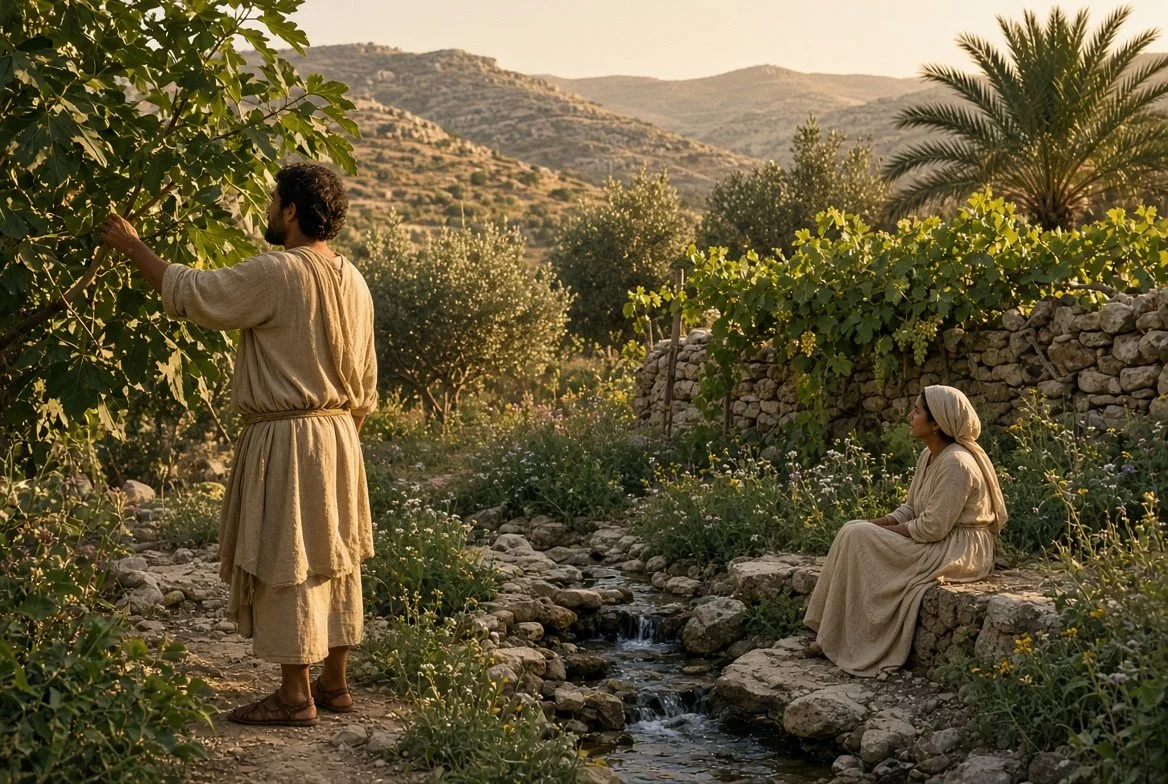
The Lord God planted a garden in Eden, in the east, and there He put the man whom He had formed. The verbs still belong to God. Planted. Put. The man does not discover Eden. He is placed there.
A river waters the garden and becomes four. Gold is already in the land, with bdellium and onyx. The wealth is not a paycheck. It is there before the man picks up a tool. This is the first holy ground: a place God plants and where He is with the man. In the middle stand two trees: the tree of life, and the tree of the knowledge of good and evil. A good world has a center. It also has a limit.
One tree is marked not his. That single “no” tells the truth about the whole garden. If he does not own that tree, he does not own the river, the gold, the soil, or the breath. He may receive what was given. He may not take what was not given. He is not the owner.
His work is given in two words that later mark holy space: work it and keep it. Work is not a curse on this page. Keeping is not fear. Together they are how a man lives in a place he did not make. He tends what God already made. He does not finish the making.
The counterpart
The world has already been called very good. One thing is called “not good”: the man alone. The animals are brought to him. He names them. No counterpart is found. Naming is real work. It does not give him relationship.
He sorts what he did not make. Kinds already stand in the week. He does not invent them. He calls them. Who instructed a man of dust to name living things according to their kinds?
The story does not stop to win that point either. Naming is still not enough. No helper fit for him is found among the beasts.
Then a deep sleep. A side is taken. A woman is made and brought to him. The man speaks, not as if he built her, but as if he recognizes a gift: bone of my bones, and flesh of my flesh. They become one flesh. The image given as male and female now stands together. They were made for each other.
They are both naked. They are not ashamed. The garden still holds.
The gift of rest
The heavens and the earth were finished, and all the host of them. On the seventh day God finished His work, and He rested. He blessed the seventh day and made it holy, because on it He rested from all His work.
Rest is not God catching His breath. The Maker is not tired. Rest means the world is received as enough. The week ends because the work is complete. A day is made holy in which nothing new is created. The high point of the week is not one more creature. It is a finished gift, held.
The man’s first full day is not a work shift. He wakes in a world already called good and is allowed to stop. Work will fill the garden. Work does not prove his worth. He earned nothing. He made nothing. His breath is given. The place is given. The woman is given. The seventh day is given. Work is how a creature tends what God made. Rest is how a creature agrees that God was right to finish.
People now often measure a life by output. Genesis measures the first human week by gift, then by care, then by a holy stop. The world is not a machine that never sleeps. The man is not a second creator. He is favored because God spoke of him and placed him, not because chance produced him and he made a name.
While the garden holds
This is the week before the break. Light before the sun and moon. A world ordered by kinds. A man formed from that world’s dust and made alive by breath he did not give himself. A garden he did not plant. A limit he did not write. A companion he did not invent. A day made holy because God stopped.
The gate is still open. No sword turns there yet.
Remember what was given. Our heavens declare it. The world is not an accident. The one who keeps it does not own it.